Projects using Jira integration for Issue Tracking
Note
This document applies only when a QMetry project is configured with a Jira project.
The Issue module provides bi-directional integration between QMetry and JIRA. You can create, view, and edit issues in QMetry, and the changes sync to JIRA. Likewise, issues added or updated in JIRA appear in QMetry.
You can perform the following tasks in the Issue module:
View, Add or Modify Jira issue details, comments, and attachments.
Map Jira custom fields with QMetry.
Access issues logged during test execution in the Issues module.
After integrating the QMetry project with Jira -
The system do not display issues added from QMetry Issues module before integration in the Issue grid.
Issues created and linked from QMetry Execution screen before Jira integration are displayed in read-only mode.
Clicking an internal issue linked from the Execution screen opens the detail window in read-only mode.
Viewing and Organizing Issues
Click the Issue Entity Key in the grid view to open the issue detail page.
Customize the grid view by resizing columns, organizing tabs, or applying filters and sorting. To learn more, refer to Manage Grid Columns.
Note
If a Jira project is integrated with a QMetry project:
Bulk operations gets disabled in the Issue module.
Column show or hide option is not available in the Issue module.
Filter the records including Jira system and custom fields.
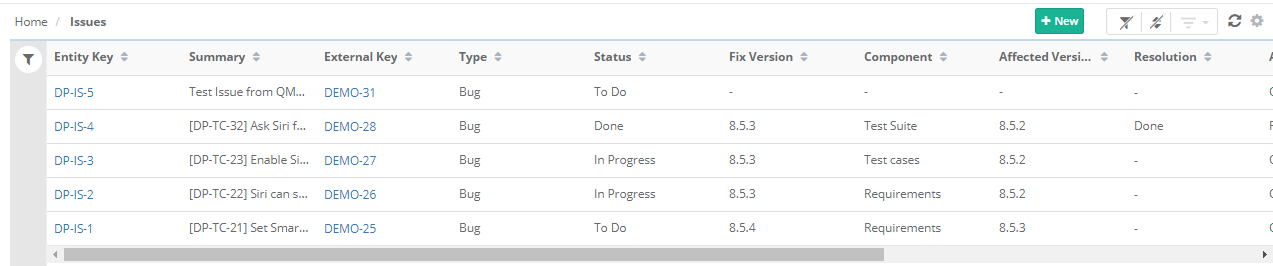 |
In the issue module, there are individual tabs for - Details, Execution Runs, Requirements, Attachments, and Comments.
Details tab
The Details tab displays issue information from Jira:
External Key: Click this Jira issue key to navigate to the Jira issue page.
Summary: View the issue summary.
Priority: Displays the issue priority as per Jira.
Issue Type: Shows the issue type synced from the Issue module during integration.
Assignee: Displays the Jira assignee.
Status: Shows the Jira workflow status of the issue in QMetry. This is a read-only field.
Reporter: Indicates the Jira user who reported the issue.
Components: Displays Jira components associated with the project.
Fix Versions: Shows Jira fix versions related to the project, typically added when the issue is resolved.
Affects Versions: Lists affected versions, usually applicable to bugs, indicating where the bug was found.
Labels Displays Jira labels in QMetry.
Resolution: A read-only field synced from Jira.
Environment: Enter details of the environment where the issue was found (Chrome, Firefox, Production, Staging).
Description: Enter the issue description in plain text.
Jira Custom Fields: View Jira custom fields such as Sprint and Severity.
Created Date: The date the issue was created in Jira.
Updated Date: The date the issue was last updated in Jira.
Resolved Date: The date the issue was marked as resolved in Jira.
Note
Watcher, Owner, and Assigned Release are not available for projects integrated with Jira.
Test Cases
This tab displays the details of the test cases linked to the issue.
Execution Runs
Issues logged from the Test Executions module are displayed here.
Note
Test Case Execution UDF details
Each execution run row displays a UDF icon beside the Execution Status. Click the icon to open a view-only panel showing the Test Run UDF values captured for that execution run.
The icon is visible only when at least one Test Case Execution UDF is defined for the project.
View Archived Test Runs
Execution runs are archived when the associated Platform, Release, Cycle, or Test Suite is archived. When a test suite, platform or Release/Cycle is archived, the test executions associated with them will be hidden on the Execution Runs tab.
To view archived test runs, select the Show Test Runs with Archived Platform(s)/Release(s)/Cycle(s)/Test Suite(s) checkbox on the Test Executions tab.
Execution Time and Remaining Time
To view Execution Time and Remaining Time for test execution, open the issue detail page and go to the Execution Runs tab.
The columns Execution Time and Remaining Time are added to the grid in the following locations within the application:
In Test Executions tab under Test Suite detail page.
In Test Executions tab under Test Case detail page.
In Execution Runs tab under Issue detail page.
Execution Time of a Test Suite: Calculated based on the estimated time of all test cases within the suite.
Remaining Time of a Test Suite: Calculated for all "Not Run" test cases after execution. Test cases marked as "Failed" or "Blocked" are also considered as having remaining work. The Remaining Time is adjusted for test cases with "Pass" and "Not Applicable" statuses.“Not Applicable” status accordingly.
Execution time | Status | Remaining time | |
|---|---|---|---|
TC1 | 2 | Pass | - |
TC2 | 3 | Not Applicable | - |
TC3 | 4 | Failed | 4 |
TC4 | 5 | Blocked | 5 |
14 | 9 |
Linking Requirements to Issues
Link single or multiple requirements to an issue through the Requirements tab on the Issue details page.
To link requirements to issues, perform the following steps.
Open the Issue details page.
Go to the Requirements tab.
Click the Link icon to attach an individual requirement or select the requirements and click Link or Link & Close.
Select the requirements. Use filters, including Labels and Folder Paths, to narrow down the list.
Click Link & Close.
Project Selection for Cross Project Association
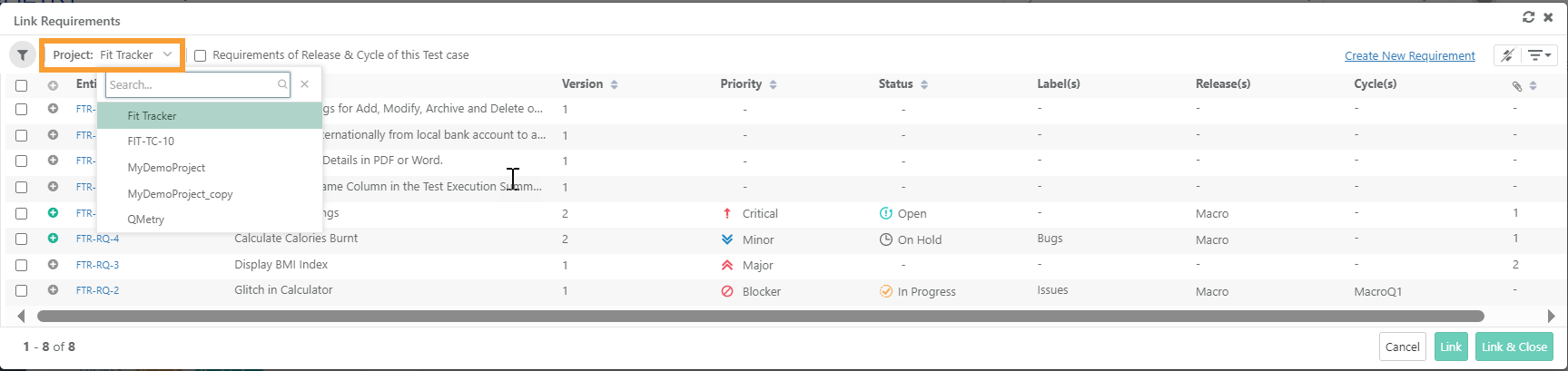 |
You can link requirements from multiple projects. Select the project containing the requirements to link.
To link requirements across projects, select a project, link its records, then switch to the next project. Remember, switching projects clears previous selections, so click Link before moving on.
Viewing Linked Requirements
The system links the selected requirements to the issue, and the linked records are displayed on the screen.
If a requirement belongs to another project, clicking the Entity Key opens the requirement in that project. You are automatically switched from the current project.
Unlink Requirements
Go to the Requirements tab of the issue.
Go to the Requirements tab of the issue.
To unlink a single requirement, click the Unlink icon for the requirement. The requirement is unlinked after confirmation.
To unlink multiple requirements, select the requirements and click Unlink Selected.
Attachments
View, download, add, and delete Jira attachments in QMetry. Refer to Managing Attachments to know more.
Comments
View, add, edit, and delete Jira comments in QMetry. Refer to More Features to know more.
Logging issues from Issue Module to Jira
To log issues from an issue module, perform the following steps:
Open the Issue module.
Click New.
Note
Logging an issue for the First Time
Authenticate using Jira Username and Password (if Server Jira) or API Token (if Cloud Jira) to authenticate and modify the Jira entity.
Username: Enter Username.
API Token: Follow the steps mentioned in the article Login using API Token to generate API Token.
Select Jira Instance, Jira Project and Issue Types. The system displays the fields as per the selected Issue Type. The fields are shown as mandatory or optional as per their project configuration in Jira.
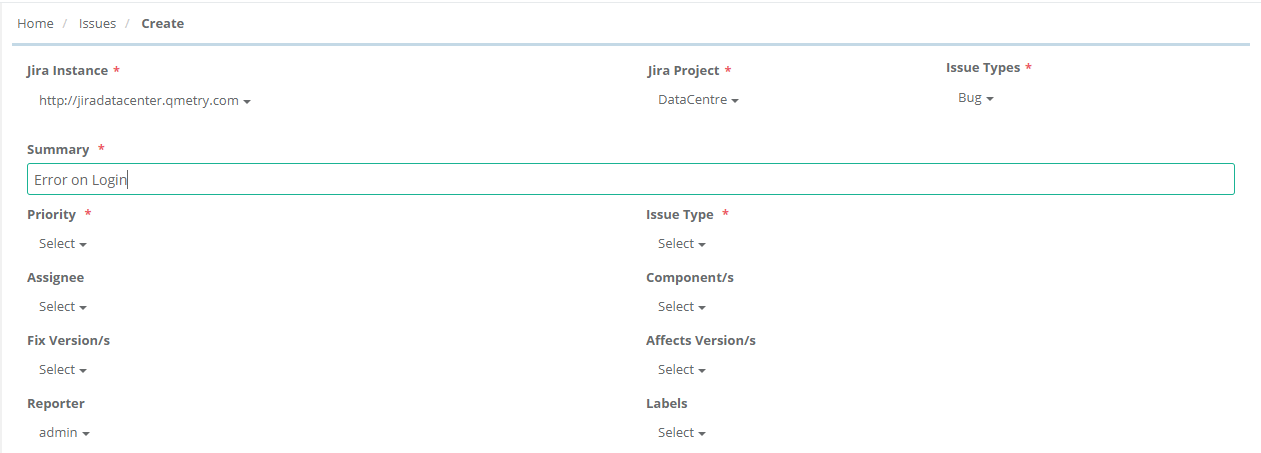
Issues added from the Issue module or Execution screen are created in Jira.
External Key: Opens the issue detail page in Jira.
Entity Key: View the issue detail page in QMetry .
Enter issue details:
Without Jira Configuration: Enter details in QMetry fields.
With Jira Configuration: The add issue screen displays Jira fields to complete.
You can add defects from both the Issue module and Execution screen in QMetry.
Fill in the issue details as follows:
Summary: Add the issue summary.
Priority: Select the priority from the Jira list.
Issue Type: Choose the issue type synced with the Issue module.
Assignee: Enter the first three letters of the Jira user to populate the list.
Status: This field is not available during issue creation. The default Jira status will be auto-selected.
Reporter: Enter the first three letters of the Jira user to populate the list.
Components: Select the Jira components for the project.
Fix Versions: Select the Jira fix versions, usually added when the issue is resolved.
Affects Versions: Choose the affected versions, typically for bugs, to indicate where the bug was found.
Labels : Select Jira labels available in QMetry
Environment: Enter the environment where the issue was found (e.g., Chrome, Firefox, Production).
Description: Describe the issue using Jira Wiki Editor formatting if needed.
Jira Custom Fields: Enter Jira custom fields such as Sprint and Severity.
Link Attachments: Attach files during issue creation.
Status
After adding the issue, the following tabs appear: Details, Execution Runs, Requirements, Attachments, and Comments.
Editing Issues Details
Once the issues are added, open the Issue details page to view or edit the details. Use an inline editor to edit issue details.
Note
Jira issue Status, Issue Type and Resolution are read-only fields in QMetry and can not be edited.
Logging Issues from the Execution Screen of the Test Suites Module
To log issues at both the test case and test step levels, perform the following steps:
Open the Execution screen.
Click the bug icon next to the test case or test step to log an issue. For more details, refer to Adding or Linking Issues to Test Case and Test Step
Creating Issues at the Step Level for Automated Test Cases
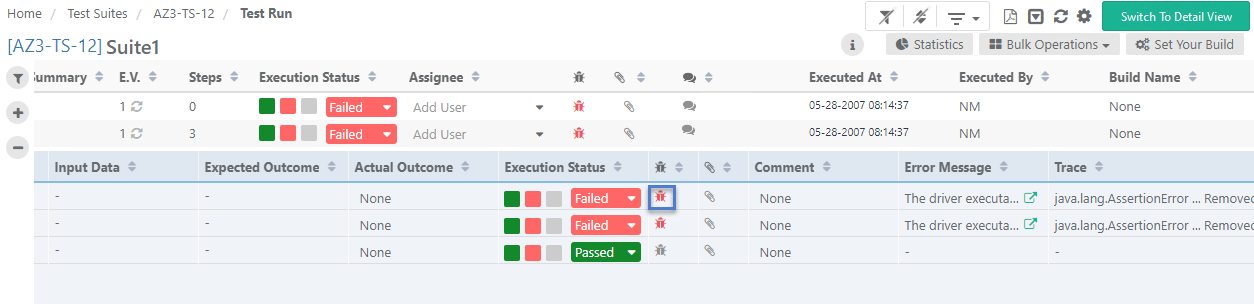
During an automated test run, if an error occurs, the system shows an Error Message and Trace on the test execution screen. When you create an issue at the test step level, the system automatically attaches a .txt file with the Error Message and Trace to the issue.
On opening the issue in QMetry, the Attachment tab shows the .txt file attached to it which contains the Error Message and Trace.
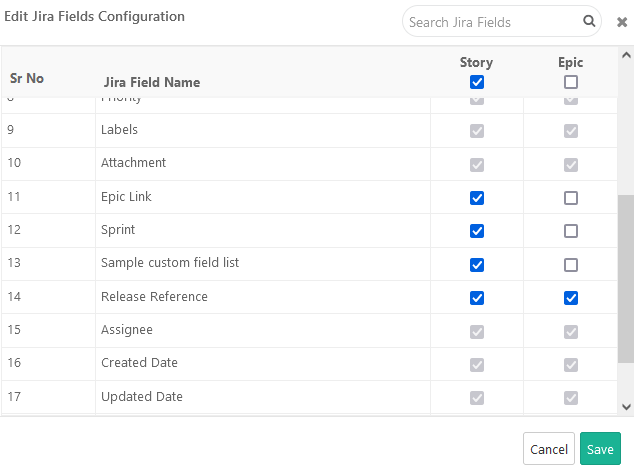
Map Jira custom fields with QMetry
System fields are automatically mapped and displayed as read-only. Users can select custom fields to map, which then appears in the Issue module.
To make the Reporter field mandatory, turn on the flag.
 |
Create Requirement from Issue
To create a requirement from an issue, perform these steps:
Select the issue and add a new requirement.
The new requirement copies common field values from the issue and use the same name. These fields can be edited.
When you create a new requirement from an issue, the system links the issue to the requirement. The new requirement appears on the Requirements tab of the Issue details page. The originating issue appears in the Issues section of the Requirement details page. Only users with Create permission for Requirements can perform this action.
From the toolbar: Select an issue in the grid pane, click "Add" on the toolbar, point to "From Issue," and select "Requirement."
From Context Menu: Right-click an issue in the grid pane, point to "From Issue," and select "Requirement."
Delete Issue
You can delete Jira issues from QMetry only if they are no longer mapped. If you delete an issue from Jira, the system removes it from QMetry, and delete its linkages to QMetry test cases or test steps.
When Jira Configuration is Removed
When you remove a Jira project integration from QMetry:
Issues created in Jira from QMetry Issue module is longer visible in QMetry.
Jira issues logged during execution loses their association with test cases or test steps in QMetry.
Issues created in the QMetry internal tracker before Jira integration reappears in the issue grid.
Edit or Revoke Existing Jira Authentication
When adding an issue for the first time, the Jira Authentication window prompts for credentials.
To display the Jira Authentication window again, revoke the existing credentials:
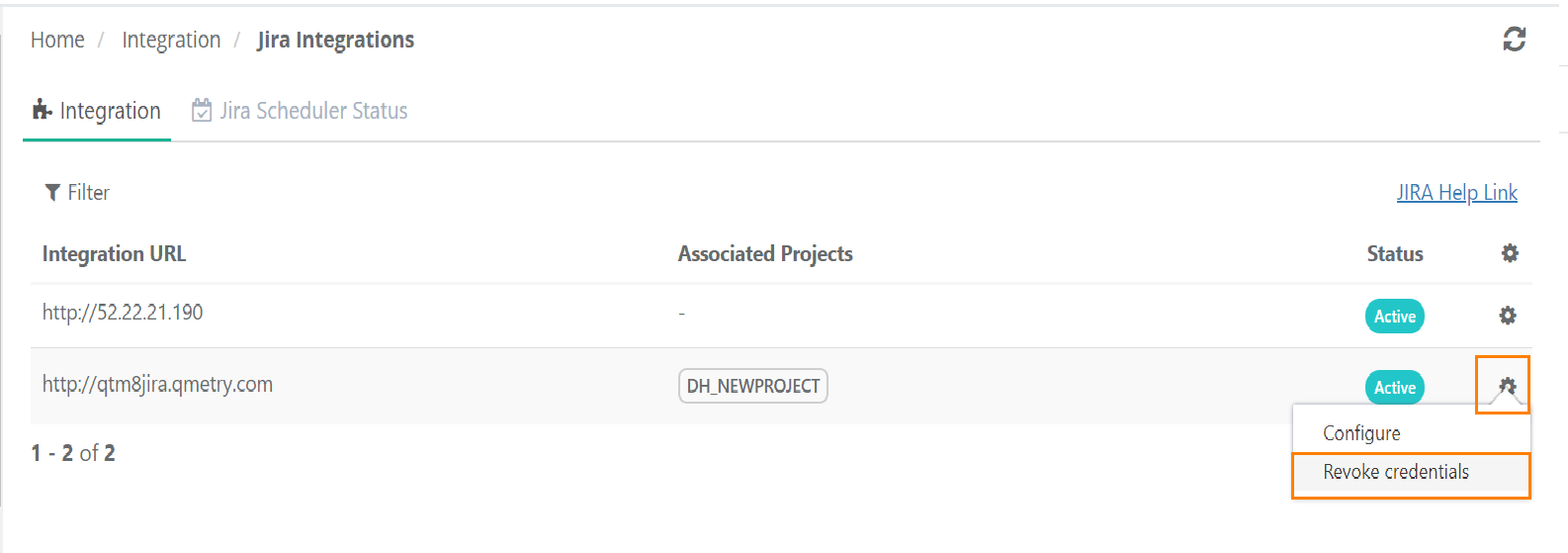 |
Go to Jira Integrations.
Click the Cog (⚙️) icon and select Revoke credentials.
Email Issue Details to Other Users
You can share defect or issue details with others, including those outside QMetry. Details include QMetry system fields, and attachments depending on the issue tracker.
If an External Tracker is integrated with Jira, details are sent in a predefined format without attachments.
To email issue details, perform the following steps:
Open the issue details page to share.
Click the Email icon at the top right.
Enter recipient email addresses, separated by commas, and send the email.