Lists
Create and manage lists for various system and user-defined fields across different asset types. Lists support Normal Lists, Lookup Lists, Multi-Select Lookup Lists and Cascading List field types. You can add or remove list values as needed to suit project requirements.
The Lists screen displays both System-Defined and User-Defined Custom Lists. Only User-Defined Lists show the Delete option. List values are project-specific, meaning the count reflects values available only within the currently selected project.
Creating a New List
You need "Modify" access to add or manage lists.
To create normal lists, perform the following steps:
Navigate to Customization and select Lists.
Click New to create a new list.
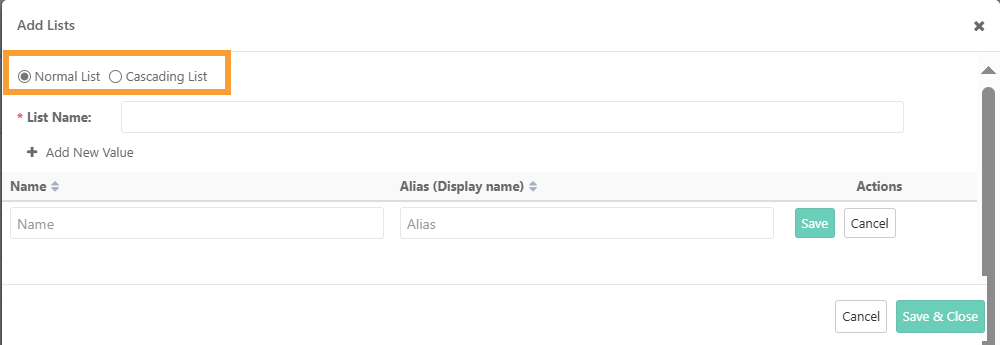
On the add list screen, select Normal List or Cascading List.
Normal List: To create a normal list
Click Add New Value and enter the following details:
Name: Must be unique for each list value.
Alias: Appears as the display name. It is case-insensitive. For example, if "None" exists, "none" cannot be added again.
Cascading List: A cascading list consists of a single-level parent-child hierarchy. This supports more structured and dynamic value entry. For example, selecting a country in the parent dropdown shows relevant states in the child dropdown.
Note
To create or modify a cascading list, you need customization permissions
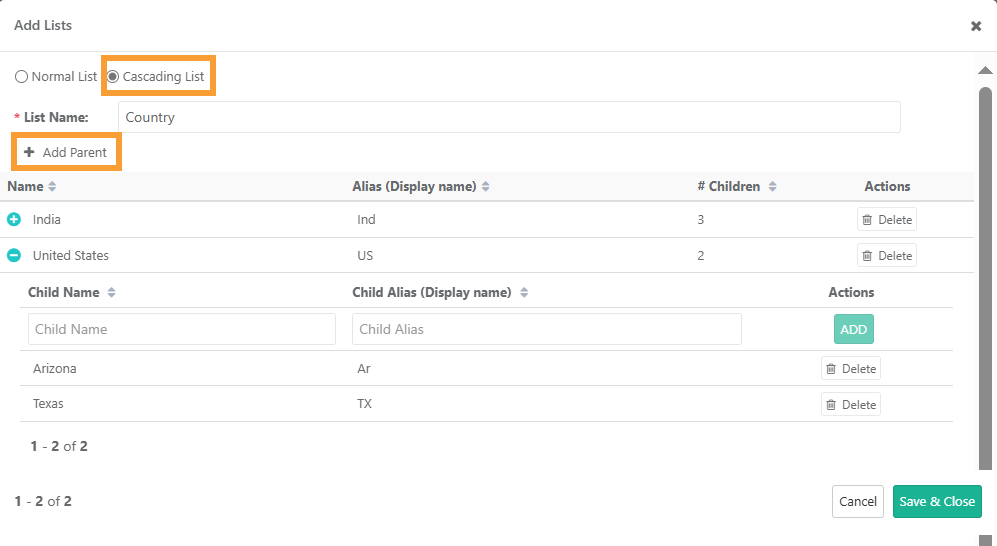
For cascading lists:
Select Cascading List and enter the List Name.
Click Add Parent to enter Parent and Child Values.
Click Save and Close.
Note
Each parent must have at least one child.
If you skip the child, the system automatically adds a default child value “No Value."
Adding a List Value
When creating a new list, whether normal or cascading, you can add the list values.
On the Add List Screen, click Add New Value.
Add List Values and Alias and click Save.
Click Save & Close.
Note
List value name validation is case-insensitive. For example, if "None" is already present in the list value, you cannot add "none" as other value.
Organizations can use the Alias field in custom lists to tailor list values to their specific needs.
Editing a List
You can edit system lists and custom lists.
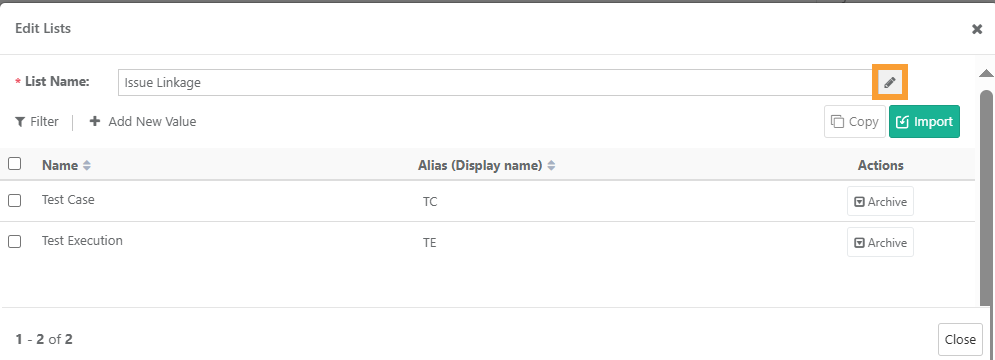
To edit a List:
Click Edit under Actions column.
You can modify the List Name, or the Alias (Display name) value as needed.
Archiving List Values
You can archive only custom list values.
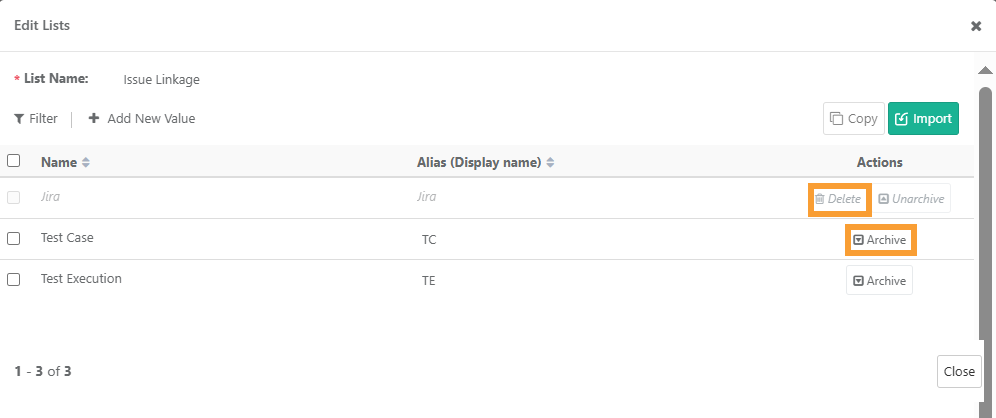
To archive a custom list value, perform the following steps:
Navigate to Customization and select Lists.
Click Edit for the desired list and select the values to archive.
Under the Actions tab, click Archive.
Notes
In case of cascading lists:
Archiving a parent value automatically archives all its child values.
You cannot archive values that are set as default.
Remove or change the default setting before archiving.
Deleting List Values
You can delete only custom list values. System-defined values cannot be deleted.
To delete a custom list value, follow these steps:
Navigate to Customization in the main menu.
Select Lists.
Locate the list you want to archive and click Delete.
Click Yes to confirm.
Note
In case of cascading lists, deleting a parent value automatically deletes all its child values.
Sharing List Values
You can copy list values, both System and Custom, from a source project to one or more target projects to ensure consistency and avoid manual entry. All copy and import actions are recorded in the Audit Log Report.
Permissions
For creating or modifying lists the user should have the following permissions:
Action | Permissions |
|---|---|
Modify list values in Source Project | Users need “View” permission to Project and Customization. |
Copy values to Destination Project | Users need “View” access to Project and “View” and “Modify” permissions for Customization. |
Importing List Values
Note
Duplicate entities for name & alias will be ignored while importing.
To import list values from other projects:
Navigate to Customization and select Lists.
Click on the Edit button of the list name.
On the Edit Lists screen, click Import.
Next, select the project from the list.
Only projects that you have access to are available in the list.
Select the list values and click Import.
Note
You can select a maximum of 100 list values at a time.
You can view the progress in the Scheduled Task section. The list values are imported to the destination project.
Copying List Values to Other Projects
To copy list values to other projects:
Navigate to Customization and select Lists.
Click Edit.
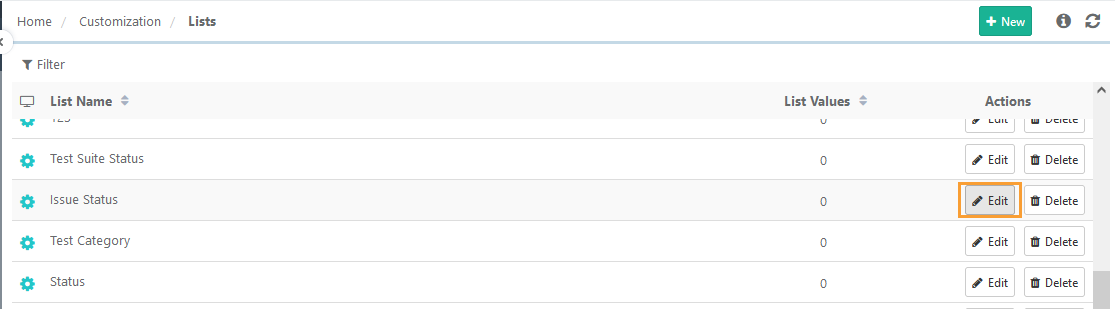
3. Select the values and click Copy.
Note
A maximum of 100 List values can be selected at a time.
4. On Copy to Other Projects dialog, select the target projects and click Copy.
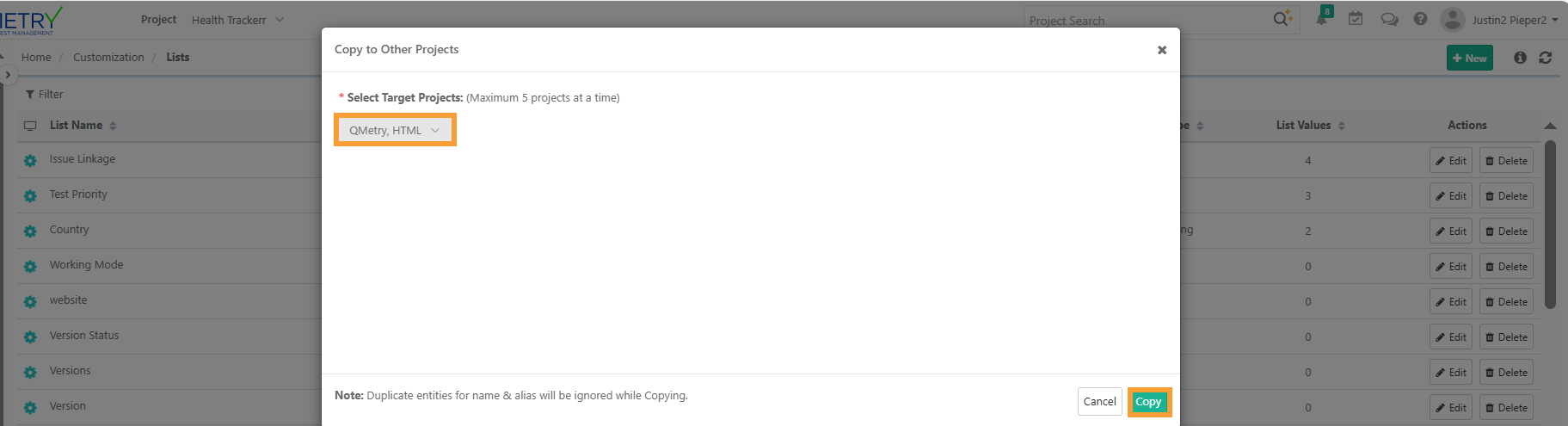
The system copies the list values to the destination project. You can view the progress in the Scheduled Task section.
Deleting a List
Note
You can only delete user defined custom lists. System defined custom lists cannot be deleted.
To delete a Custom List:
Go to Customization and select Lists.
Click Delete under the Actions column.
Select Yes to confirm Delete.

Note
You need to enable the Customization Package on your QMetryinstance to modify the above settings.