Execute Parameterized Test Cases
To execute parameterized test cases, perform the following steps:
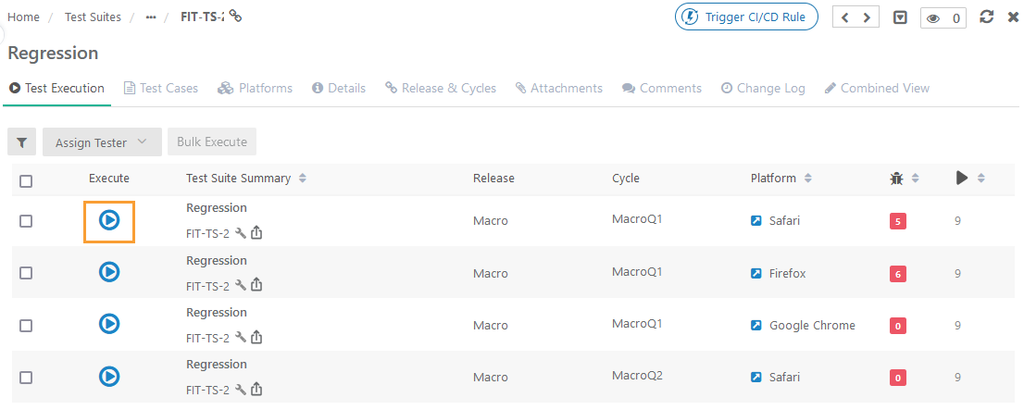 |
Go to the Test Suite Detail Page and select the Test Execution tab.
Click Expand all to expand parameterized test cases. The step count at the test case level reflects the number of test cases multiplied by the number of data sets.
Expand each Parameter Combination to view the test steps.
If Data Mapping is not done
When a parameter is added but values are not yet mapped, the test step on the Test Execution screen shows "@" , indicating that the values have not been synced in the Data Grid.
A tip on the screen provides a link to map the parameter with its value. Clicking this link opens the test suite detail page.
Go to the Test Cases section and map the Data Grid for the test case.
Refresh the Test Execution screen.
Expand the test case to see the parameter values and view the steps with the assigned values.
If a new column is added to an Existing DataGrid
Open the test suite detail page and go to the Test Cases section.
Click @ sign to access the Data Grid Mapping screen.
Click Sync Columns to update the Data Grid with the new column.
Map the values and update the Grid.
Edit In | Impact on Test Execution Screen |
|---|---|
Edit Data Grid Mapping:
| When the Data Grid is updated, changes are reflected on the Test Execution screen. The test case will be updated, and the step count will change accordingly. Editing the Data Grid from the Test Suite (for linked parameterized test cases) will only make temporary changes that do not sync with test parameter data. |
Edit Test Case: Any changes to test steps in a test case will be reflected on the Test Execution screen. Add a step to the test case and save it as a new version. | On the Test Execution screen, syncing the test case will update it to the new version, increasing the step count. Each combination will now include the newly added step. |