Importing Test Cases from an Excel File
Import multiple test cases from Excel to create new test assets in or update existing ones through re-import. Upload files with multiple sheets, maintain the test case sequence, map fields, and manage versioning.
Import test cases into specific folders or sub-folders within the Test Case module of the current project. The system retains the order of test cases as defined in the Excel file.
Note
Keep the file size within the recommended limit of 10 MB when uploading.
Convert your data in system format before importing.
Preparing Excel File
Use any of the following templates to prepare your excel for import:
TestCases with Steps in Multiple Rows_multiple worksheets.xlsx
TestCases with Steps in Single Row_multiple worksheets.xlsx
Enter comma-separated values for fields with a multi-lookup list.
Ensure that all the columns in the Excel file have a corresponding field in .
If a column does not map, create a custom field from Manage Fields.
Import excludes Graphs, Filters, Merge Cells and HTML Tags that exist in the Excel file.
To import a test case into multiple folders, use a colon-separated list of folder names.
Based on this format, select the Test Step Format while uploading the source file.
Test Case Steps in Single Row: If a test case has multiple steps listed in one row.
Test Case Steps in Multiple Rows: If a test case contains multiple steps, each step is written in a separate row.
 |
Importing Test Assets from Excel
To import from Excel, perform these steps:
Go to the Test Asset Module.
Click the Cog (⚙️) icon and select Import.
It opens the Import wizard, displaying the following steps:
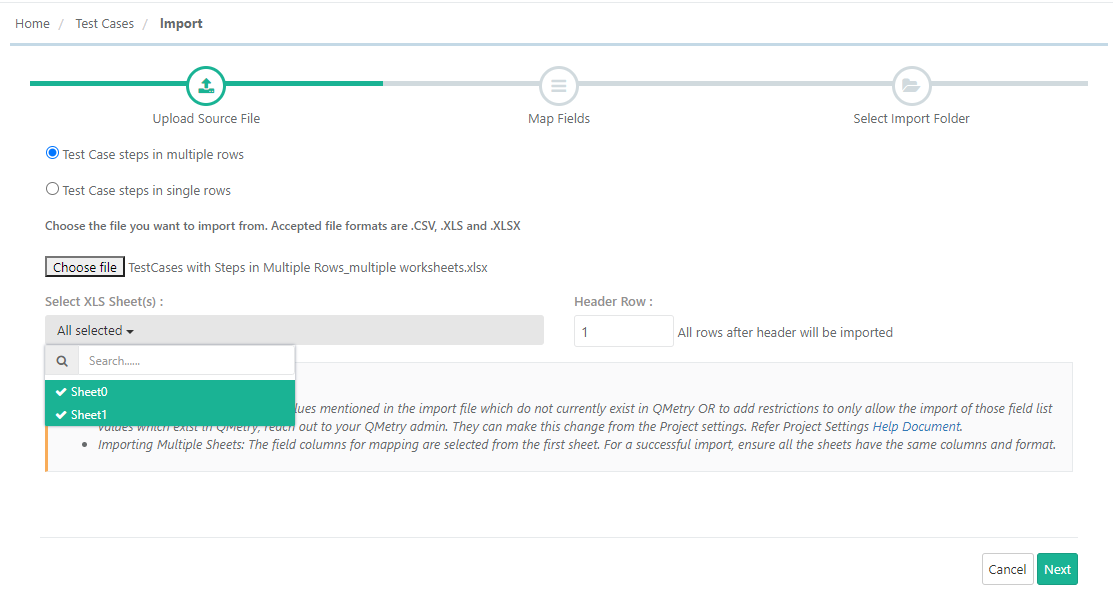
Step 1: Upload Source File
Click Choose File to browse and upload the file to import. Select at least one sheet from the Excel file.
Note
If an “Invalid file” message appears while uploading an Excel file, open the file in Microsoft Excel. Save it as an “Excel Workbook” with a new name, and then try importing the new file.
Select XLS Sheet: Select the sheets for import. Select at least one sheet that contains the requirements.
Importing Multiple Sheets: The first sheet sets the field columns for mapping. Ensure all sheets share the same columns and format.
Header Row: Enter the row number to set it as the header row. The system imports all rows below it.
Step 2: Mapping the Fields
Map each Excel field to the corresponding field.
Mandatory fields are marked in red.
Modify or remove Incorrect mappings.
Step 3: Save Mapping
Click Save Map, enter a name, and save the mapping.
To reuse, select the saved map. The system auto-applies the saved mapping.
To reuse the mapping, select the saved map. The system applies the saved field mapping.
Additional Mapping Options
Auto Map: Auto-map system and custom fields by using keywords in the header names.
My Mappings: The drop-down displays all mappings saved by the logged-in user during requirement imports. The selected map name indicates the mapping currently in use.
Click to proceed.
Select Import Folder
Select the destination folder for importing the test.
To create a new folder, select a parent folder, enter the folder name, and click Add Folder.
Create folder with sheet name: The system creates a new folder for each sheet within the file and imports test cases into the respective folders.
Import with Warning: Truncates summaries longer than 255 characters instead of rejecting them. If the checkbox is not selected, the import fails if any requirement exceeds the character limit.
Click Finish to complete the Import wizard and start the import process.
Track the progress on the application header.
Re-importing Test Cases
Re-import modified test cases to update existing ones.
When re-importing test cases that already exists in the project, note the following points:
If you select the same folders as the current ones, the test case remains unchanged. It stays in its original location and keeps all existing folder associations.
If you select different folders, the test case is reused in the newly selected folders. It retains its original folder associations, and the newly selected folder paths are added.
If a selected folder does not exist, the system automatically creates it during the reimport process.
Note
Folder associations can only be added, not removed, via re-import.
To re-import test cases, perform the following steps:
Export test cases from via Bulk Operations.
Make edits in Excel.
Re-import using the same steps as for new test cases.
Note
The system increments the version number by 1 for each re-import.
Mapping the Fields (Mandatory and Optional)
Map all mandatory fields:
Map Entity Keys to update the right test case.
Map Summary and all required fields.
Map Folder Path only if moving assets to a different folder.
Unmapped fields retain values from the previous version.
Remove incorrect field mapping individually.
Save Mapping Configuration.
Select Import Folder.
Click Next
Note
You can have blank columns, headers, or sheets during upload. Organizations may use the first sheet or initial rows for content like a name, logo, or introductory text instead of actual test cases.
Reimporting Test Cases Containing Linked Shareable Test Cases
During re-import, the system creates a new version of each test case, preserving links to the Shareable Test Cases while applying changes from the Excel file.
The rest of the process is the same as outlined in Importing Test Cases Containing Linked Shareable Test Cases.
 |
The shareable test case link remains intact. You can click the entity key to access the shareable test case.
Note
Map or unmap the Shareable Test Case Key and Shareable Test Case Version Number fields during import.